

If you’ve walked into a hotel lobby, sports bar or car dealership showroom and stopped to look at a screen that is clearly bigger than any TV you can buy for your home, you’ve seen a video wall. Video walls have come a long way from stadiums and control rooms because the hardware is cheaper and the software is easier. A video wall that used to be seven-figures is now a realistic line item for a restaurant, clinic or lobby.
When looking to purchase a video wall, the vocabulary can become technical fast. LED or LCD. P1.5 or P2.5. Bezel width, nits, cabinets, view distance. Here’s what it all actually means, so you can read a proposal or quote and understand what you’re choosing.
What is a video wall?
A video wall is a large display surface built from multiple smaller displays tied together and powered as a single screen. While large panels typically cap out between 98 and 110 inches, you can build the size and shape you desire out of modular parts, and a processing system treats the whole surface as one screen or canvas, if you will.
A video wall can be as wide as your lobby, L-shaped around a corner or curved along a reception desk. You can run one image across the entire surface, split the surface into zones or alternate throughout the day.
There are two technologies that lead commercial video walls, and they work in different ways:
LED vs LCD video walls: what’s the difference?
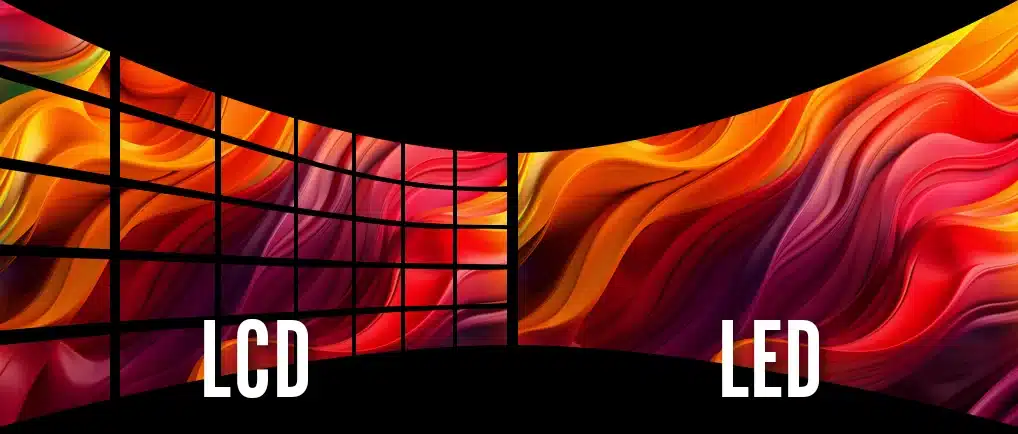
- What is an LCD video wall?
An LCD video wall is a grid of commercial-grade LCD panels, typically 55-inch, mounted in a tight array. Each panel is a very thin monitor with an ultra-narrow frame synchronized to display one image across a grid.LCD panels are backlit, meaning a light source behind the screen shines through a liquid crystal layer that filters it into the image people see. Because they’re standard manufactured panels, they pack a lot of pixels into a small area, and they cost less per square foot than LED. The difference is the frame. Every panel has an edge, so every LCD wall has a visible grid running through the image.
- What is an LED wall?
An LED wall, also called a dvLED, has no panels in the sense that LCD has. It’s built from modular cabinets covered in tiny LED chips, where each pixel is its own light source. Nothing is backlist, and nothing is filtered. The LED emits the image directly.With edge-to-edge pixels, an LED wall appears seamless. There is no grid line, at any size. LEDs also get dramatically brighter than LCD with indoor walls commonly running 800 to 1,500 nits vs 500 to 700 for LCD. An outdoor-rated LED can go past 5,000 nits, bright enough to hold up in direct Texas sun.
| Feature | dvLED video wall | LCD video wall |
|---|---|---|
| Seams | None — fully seamless | Visible grid, roughly 0.9–3.5 mm between panels |
| Brightness (indoor) | ~800–1,500 nits | ~500–700 nits |
| Outdoor use | Yes, purpose-built at 5,000+ nits | Not practical for most applications |
| Shape and size | Any size, any shape, extendable later | Rectangular grids only, fixed increments |
| Pixel density | Lower — set by pixel pitch | Higher — great for close-up detail |
| Lifespan | ~100,000 hours to half brightness | ~50,000–60,000 hours |
| Service | Swap an individual module | Replace a whole panel |
| Cost | Higher upfront, especially at fine pitches | Lower upfront at small and mid sizes |
Explaining pixel pitch
Pixel pitch is the distance in millimeters from the center of one LED pixel to the center of the next. It’s written with a P. So P12 means 1.2mm between pixels and P4 would indicate 4mm. The smaller the number, the more closely the pixels are packed together, creating a sharper image range. This means the smaller the pixel pitch, the more expensive it will be because you’ll be buying more LEDs per square foot.
However, pixel pitch does not equal quality. It’s a viewing distance specification. A P4 wall isn’t worse than a P1.2 wall; it’s just built for people standing further away. Buying a finer pitch than your room or space requires is one of the most common ways buyers overspend on a video wall. Pixel pitch is an LED term, and LCD panels have a fixed resolution, so their pixel density is decided by the panel you buy and is not something you need to specify.
A good rule of thumb is 1mm of pixel pitch per one meter (or three feet) of minimum viewing distance:
| Pixel pitch | Comfortable viewing from | Typical Use |
|---|---|---|
| P0.9 – P1.5 | ~3–5 ft | Boardrooms, reception desks, retail counters — anywhere people stand close |
| P1.5 – P2.5 | ~5–8 ft | Corporate lobbies, restaurant dining rooms, showrooms |
| P2.5 – P4 | ~8–13 ft | Large lobbies, entertainment venues, big-box retail |
| P4 and above | 13 ft and beyond | Outdoor signage, stadiums, large venue walls |
What is the bezel?
The bezel is the frame around an LCD panel. In a video wall, what matters most is the combined bezel, the two panel edges added together. This becomes the width of the dark line running through your image.
Commercial LCD panels advertising combined bezels as narrow as 0.88mm, although the line is still visible. With segmented content, the grid lines aren’t really noticed, but with a full image bleed across the panels, the grid is often the first thing the eye notices.
When planning for a video wall, the team at Mood Texas looks at three things to start: the wall, the distance it will be viewed from and what will go on the screen. Video walls are heavy and generate heat, making it important to have the right structural backing, ventilation and power pathways to ensure the installation is safe and secure. Viewing distance and sightlines determine pixel pitch, mounting heights and brightness. We measure (and remeasure) the room before specifying any equipment. Lastly, if a video wall is used to display information, bezels are fine and we would recommend LCD panels. If the video wall is for viewing entertainment and making an impression, we would recommend LED panels.
At Mood Texas, we design, install and support video walls and other digital signage for businesses. If you’re considering a video wall for a lobby, dining space, showroom or conference room, contact us today to get started.
Frequently Asked Questions
What is a video wall?
A large display surface made of multiple display units tiled together and driven as one screen, allowing sizes and shapes that a single panel can’t achieve.
Is LED or LCD better for a video wall?
Neither is universally better. LCD costs less and packs more pixels per inch, making it a strong choice for smaller walls, close-viewing detail, and segmented content. LED is seamless, far brighter, builds to any shape, and lasts roughly twice as long — which makes it the standard for lobbies, storefronts, large spaces, and anywhere outdoors.
What pixel pitch do I need?
Start with your closest realistic viewing distance. As a rough guide, allow about 1 mm of pixel pitch per meter (roughly 3 feet) of viewing distance, then let content type and budget adjust it from there.
Do LED video walls have bezels?
No. Direct-view LED cabinets tile with pixels continuing across the join, so the image is unbroken. Only LCD video walls have visible seams.
How long does a video wall last?
Quality dvLED is generally rated around 100,000 hours to half brightness. Commercial LCD panels typically run 50,000 to 60,000 hours.
Can a video wall be expanded later?
LED walls can. As long as you add cabinets of the same model and pixel pitch, an existing wall can be extended or reshaped. LCD walls are limited to whole-panel rectangular increments.